Protecting a harvest starts with anticipating it
Alerts on your configured plots, not on your department. The precision that makes the difference between acting in time and taking the hit.
The storm: the farmer's first economic enemy
Total cost of climate-related insurance claims in France in 2025, of which 2.2 billion attributed to hail episodes alone (source: France Assureurs, March 2026).
Vineyards hit in the Dordogne in a single episode in July 2024, with losses reaching 90% on some plots (source: Dordogne Chamber of Agriculture).
For a farmer, a hailstorm isn't an abstract risk. It is the potential destruction of everything sown, planted and tended since spring. Part of the damage can be reduced with effective anticipation: deploying hail nets, bringing in equipment, protecting sensitive crops, moving livestock.
Hail: a threat that strikes fast and extremely locally
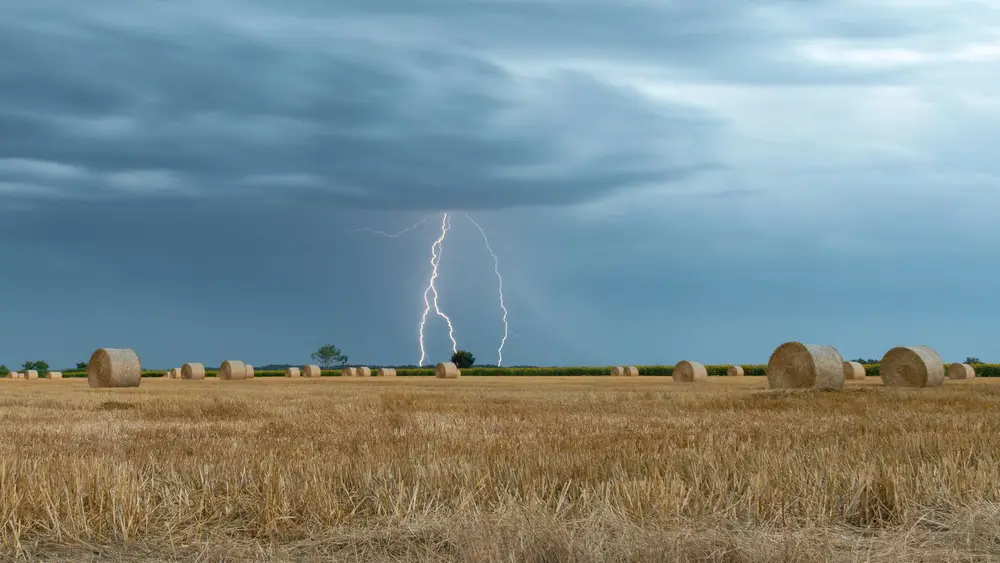
Hail's most deceptive trait is how localized it is. A hail-producing storm cell can devastate a band a few kilometres wide while leaving the neighbouring area untouched. Farms 10 kilometres apart can meet radically different fates in the same episode.
This spatial concentration makes general-purpose alerts particularly unsuited to farming. An orange warning over a whole department doesn't say whether the hail band will pass over the vineyards in area A or the market-garden crops in area B.
Climate studies published in recent years document a rising trend of intense hail episodes in France, with large hailstones (over 5 cm) increasingly frequent. Regions that farmed with moderate risk are seeing their exposure shift.
The most exposed crops
Viticulture
A perennial crop: damage to the canes can compromise this year's harvest and next year's. Hail nets must be deployed before the hailstones arrive, not during.
Market gardening
A hail episode can destroy a harvest in minutes. During the 2015 storms, 50% of market gardeners in the Paris region were hit, with 1,000 ha damaged in Seine-et-Marne.
Field crops
Maize, wheat, sunflower: significant risk during grain formation. The main available action is fast documentation for claim procedures.
Livestock
Lightning and violent storms: direct risk to animals at pasture. Sheltering herds takes time depending on the size and distance of the plots.
Orchards
Plum, walnut, almond, blueberry: losses can reach 20 to 90% depending on the episode's intensity. ISN threshold of 30% for orchards.
Greenhouses and structures
Gusts and hail: risk to tunnel greenhouses, protective tarps, light structures. Preventive closure before the phenomenon arrives.
What Storm Predict changes for farming
An alert on your plots, not on your department
You set up your plots, your farms and your grazing areas as monitoring spots. When a storm cell with hail or lightning risk is identified on a trajectory toward your areas, you receive a precise alert. Accuracy under 10 km lets you know whether your farm is on the trajectory or whether the cell will pass to the side.
Deploying hail nets, protecting sensitive crops, securing equipment.
Sheltering animals outdoors, stopping farm work in open fields.
Securing tunnel greenhouses, protective tarps, unfixed light structures.
Agricultural insurance and traceability
Storm Predict keeps a timestamped, geolocated history of alerts that objectively documents the passage of a storm cell over the configured plots. This documentation can be useful for claim declarations to insurers and compensation bodies (ISN, multi-risk climate insurance).
Service limits
Storm Predict is not a hail-protection system. It does not replace hail nets, multi-risk insurance contracts or specific protection protocols. It provides the lead time needed for the available protections to be activated in time.
Summary of benefits
Storm Predict for farming
- Alerts on your configured plots, not on your department
- Differentiation between lightning, hail and gusts
- Accuracy under 10 km on configured areas
- Predictive trajectories up to 4 hours with a confidence index
- Multi-plot management for scattered farms
- Timestamped alert history for claim procedures
Every season counts. Let's talk about yours.
Every farm has its own crops, protective equipment and constraints. A 30-minute call to identify the concrete benefits.